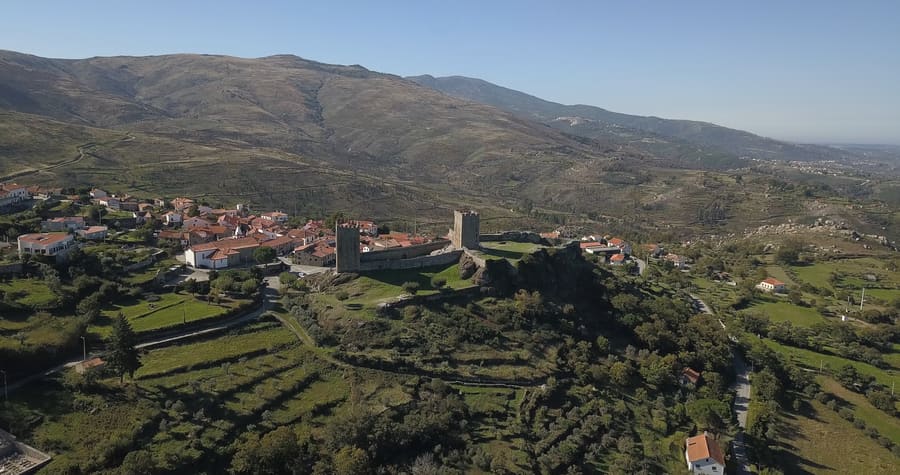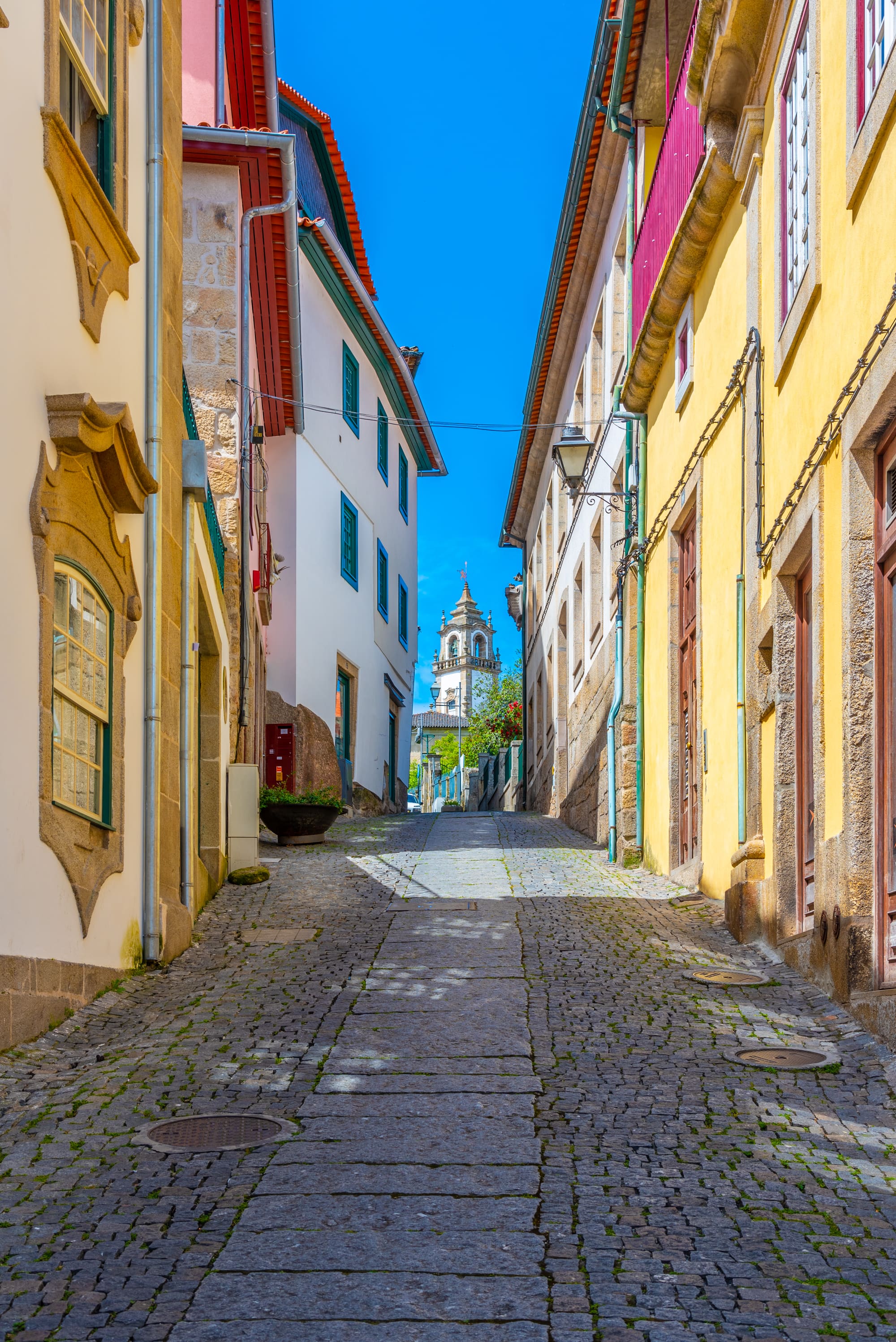
Viseu’s historic centre is compact and easy to explore on foot — the whole core fits within a circle less than a kilometre across. But “compact” doesn’t mean “flat”: the old town sits on a granite hill, and you’ll constantly climb and descend lanes that are sometimes barely two metres wide.
That vertical layering is exactly what makes the Alta (upper town) so special. Every corner offers a new view over the rooftops, the vineyards below, or the façade of a church you didn’t see coming.
The walking route: 3 hours, in order
This route follows a logical line from top to bottom — you start at the Sé at the summit and finish at the Rossio below. Total walking distance: about 2.5 km. With stops at every sight, allow 3 to 4 hours.
Stop 1: Praça da Sé — the heart of the upper town
Start at Praça da Sé, the square in front of the cathedral. It’s the highest point of the old town and the most open. Take a minute to take it all in: the imposing portal of the Sé, the former bishop’s palace beside it (now the Museu Grão Vasco), and the viewing terraces at the edge of the square.
Orientation: the Sé stands at the highest point of the Alta. Everything runs downhill from here.
Stop 2: Sé de Viseu (cathedral)
The Sé de Viseu is the region’s most important church and one of the most impressive cathedrals in Central Portugal. Its building history spans more than eight centuries, from the Romanesque foundations of the 12th century to the Baroque reconstruction of the west front in the 18th.
Don’t miss:
- The Manueline vaulting in the nave — stone carved like a net of ropes and cables, typical of the Portuguese style of the early 16th century
- The choir with 18th-century azulejo panels depicting biblical scenes
- The sacristy (separate entrance, sometimes closed): 16th-century wall paintings and chapter furniture
Practical: Praça da Sé · Daily 9:00–12:30 and 14:00–18:00 · Free entry to the nave · Keep your voice down — the cathedral is very much in use
Stop 3: Museu Grão Vasco
Right next to the Sé, in the former bishop’s palace (16th–17th century), is the Museu Grão Vasco — one of Portugal’s most important art museums outside Lisbon and Porto.
The collection is built around Vasco Fernandes (c. 1475–c. 1542), known as Grão Vasco (“the great Vasco”). He was the leading painter of the Viseu school, a Portuguese strand of the Ibero-Flemish Renaissance. His altarpieces, originally painted for the cathedral, are why Viseu is on the art-history map.
Don’t miss:
- The Pentecost altarpiece (Grão Vasco, c. 1535): panels with a refinement of colour and composition that wouldn’t look out of place in a major European gallery
- The Adoration of the Magi, in which one of the three kings is painted as a Brazilian native — one of the earliest depictions of Brazil’s indigenous people in European art, made only a few decades after the Portuguese reached Brazil
- The upper gallery with works by Grão Vasco’s contemporaries and followers
Practical: Adro da Sé · Tue–Sun 10:00–18:00 · Closed Mondays and public holidays · €5 / under-12s free / students €2.50 · Audio guide available in Portuguese and English
Allow 1–1.5 hours for a full visit.
Stop 4: Rua Direita — the medieval high street
Leave Praça da Sé via Rua Direita (“straight street”), the main link between the upper and lower town. In the Middle Ages it was Viseu’s commercial artery, and in a sense it still is: small shops, craftspeople and cafés alternate in buildings that often keep their 17th- and 18th-century fronts.
Take time for the details: carved wooden window frames, granite doorways with coats of arms, and here and there a glazed azulejo panel decorating a house front.
Tip: along Rua Direita you’ll find small, nameless cafés that serve an excellent galão (Portuguese milky coffee). The locals know where to go — follow them.
Stop 5: Igreja da Misericórdia
Halfway down, on a small square near Rua Direita, stands the Igreja da Misericórdia — an 18th-century Baroque church with a striking white-and-granite façade. It’s less imposing than the Sé but more intimate: a place to sit for a moment, enjoy the quiet and study the Baroque details with no one else around.
Practical: small church · Irregular opening hours · Free
Stop 6: Rossio — Praça da República
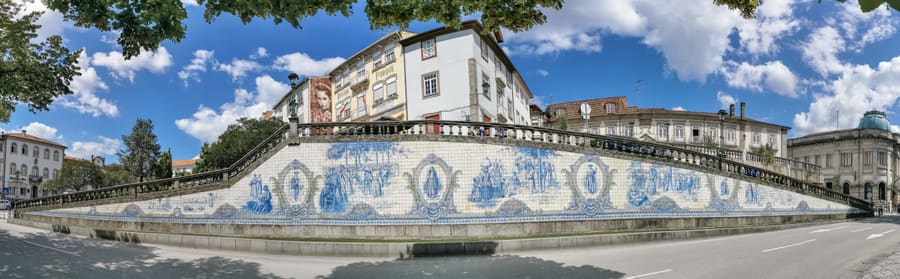
The walk ends at Praça da República, always called the Rossio by locals. It’s the central square of the lower town and the liveliest part of public life in Viseu: markets, festivals and everyday bustle, all on a square dominated by the great azulejo panel.
The Rossio azulejo panel is the work of ceramic artist Joaquim Lopes, made in the 1930s. It shows historical and rural scenes from the region in the blue-and-white tradition of classic Portuguese tilework. The scale is impressive: about 20 by 5 metres.
Photograph it at blue hour — early morning or just before sunset — when the blue of the tiles almost melts into the sky. It’s the most iconic view of Viseu.
Off the route: what most visitors miss
Parque Aquilino Ribeiro
Right next to the historic centre is a large city park named after Viseu-region writer Aquilino Ribeiro (1885–1963), one of the great Portuguese authors of the 20th century. A green oasis in the middle of town — ideal for a picnic or a stroll after the museum.
Porta dos Cavaleiros
One of Viseu’s surviving medieval town gates. The Porta dos Cavaleiros (“Knights’ Gate”) marks an old entrance to the walled town and is often overlooked by visitors who don’t walk the full line of the old walls.
Casa-Museu Almeida Moreira
A small museum in a private villa, home to the collection of Viseu’s first museum director, Francisco Almeida Moreira: azulejos, furniture, ceramics and paintings. Few visitors, high quality.
Practical: near the Rossio · Limited opening hours — check the municipal tourism website before you go
Frequently asked questions about Viseu’s old town
Is Viseu’s historic centre easy to walk?
Yes, but expect cobbles and noticeable climbs. The Alta sits on a granite outcrop and you’ll go up and down constantly. Comfortable shoes are essential — no heels, and nothing with slippery soles on wet stone. People with limited mobility can reach most places via detours, but Rua Direita has steps in places.
How much time do I need for the historic centre?
For a quick visit (Sé plus the Rossio) allow at least 2 hours. For the full picture including the Museu Grão Vasco and a coffee on Rua Direita: 4 hours. Add Parque Aquilino Ribeiro and lunch in the upper town and it becomes a full day.
What’s the best time of day to visit?
Early morning (9:00–11:00) is ideal for the Sé and the museum: fewer visitors, a calmer atmosphere and better light. The Rossio is liveliest from 18:00, when locals meet for an aperitif. Summer middays are hottest — do as the Portuguese do and slow down between 13:00 and 15:00.
Is there parking near the historic centre?
Yes. The largest underground car park is beneath Praça do Município, next to the town hall on the edge of the old town. Around €1.50 an hour, within walking distance of all the sights. Alternatively, there’s street parking in the neighbourhoods at the foot of the hill.
Is the Museu Grão Vasco worth it if you’re not into painting?
A fair question. The museum’s focus — Portuguese Renaissance painting — is specialised. But even without a particular interest in art, the building itself (a 16th-century palace) and the Adoration of the Magi panel are culturally remarkable. Allow 45 minutes if you’re not an art lover.
Are there guided tours in English?
Yes. The Viseu tourist office (VISITviseu, on the Rossio) can arrange official guided tours in English, and the Museu Grão Vasco has an English audio guide. Or simply follow the self-guided route on this page at your own pace.
Read more: Viseu travel guide · Shopping in Viseu · Where to eat in Viseu
Some links are affiliate links: if you book through one, we earn a small commission at no extra cost to you. Prices are indicative — always check when booking.